Ipas LAC’s Annual Report shows how health services, community networks, scientific evidence, digital tools and work with decision-makers are expanding access to information, contraception and safe abortion in the region.
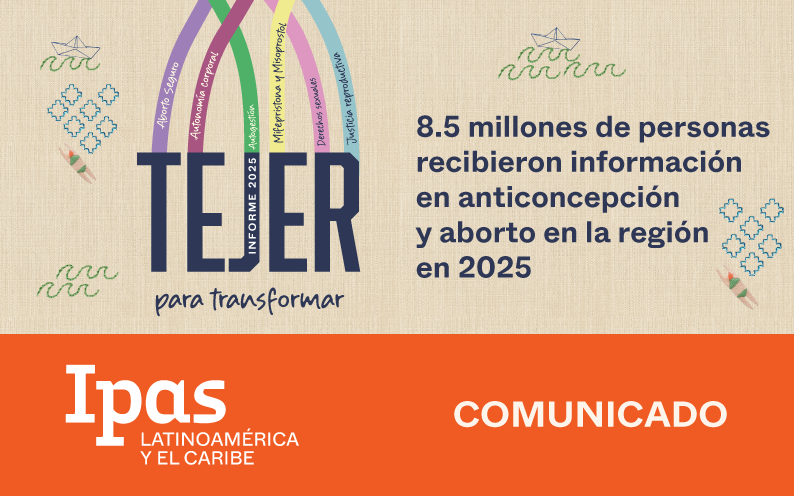
In 2025, while the public debate on abortion in the region has focused on legal changes, 8.5 million people in Latin America and the Caribbean received safe information on contraception and abortion. At the same time, more than 151,000 accessed pregnancy termination services in health facilities in health facilities accompanied by Ipas LAC, and 20,000 were directly accompanied by community networks in contexts where access faces legal, geographic or institutional barriers.
These are some of the findings of the Ipas LAC Annual Report 2025, Weaving to Transformwhich documents how access to sexual and reproductive health is built in practice every day through reliable information, adequate health services, community accompaniment, digital tools and public advocacy processes in the different countries of the region.
Among the most relevant results of the year are the following:
More prepared and accessible health services
In Argentina and Chile, Ipas LAC worked with health-care providers to strengthen clinical and spokesperson capacity, as well as to consolidate Good Practice Centers that today serve as reference points for other health units in the area. In Colombia, health professionals participated in international forums for the exchange of scientific evidence on abortion, migration and innovation in health. The quality, accessibility and availability of services for those who need them are strengthened.
Networks in contexts of criminalization and legal restriction
In Central America and other countries with restrictive contexts, community networks directly accompanied thousands of people with safe information and support during their reproductive autonomy processes.
In order to overcome threatening contexts, support networks are constantly generating creative alternatives to inform and protect women’s and people with the capacity to bear children. One of the most innovative initiatives is the platform: Accompanied abortion in Central America (ACA Abortion), regional information tool designed by activists and accompaniers. This tool is an example of the use of technology to help guarantee the right to information and reproductive self-determination for those whose options are limited by restrictive and criminalizing laws. More than 500 requests for information from different countries in the region registered on the ACA Abortion platform confirm the need to continue working on safe options for access to reproductive health.
Innovation to expand access to secure information
In Mexico we expanded the map of points of sale of safe abortion medication in Mexico, reaching 914 pharmacies with availability of these supplies, which makes itThis makes it easier to identify where to buy them reliably.
Digital tools for accompaniment were also strengthened, such as the chatbot Te AcompañoThe program is aimed at people in mobility contexts in Mexico or in transit who need safe information. In addition, informative microsites on abortion and contraception for the local population were expanded.
Direct impact with decision-makers
Expanding access to safe abortion involves not only strengthening services and networks, but also working with decision-makers. In a regional context of legislative debates marked by misinformation and stigmatization, Ipas LAC launched the Navigating the Green Tide workshops, which brought together legislators to strengthen their understanding of access to abortion as an essential health service and a right to abortion.workshops, which brought together legislators to strengthen their understanding of abortion access as an essential health service and a right of women and pregnant women.
Evidence to address misinformation
The report also presents research on the transnational transnational articulation of anti-rights groups, with case studies in Guatemala, Argentina and Chile.The report also presents research on the transnational articulation of anti-rights groups, with case studies in Guatemala, Argentina and Chile, as well as processes of dialogue with justice systems, such as the meeting between Honduran magistrates and civil organizations in Mexico to incorporate a gender perspective and a rights-based approach in the administration of justice.
“Access to abortion and contraception in the region depends on the existence of laws, networks, trained health personnel, safe information and strategies to deal with adverse contexts. This report shows how that access is woven into practice,” said Diana Moreno, the new executive director of thesaid Diana Moreno, Ipas LAC’s new executive director.
The publication of the report also marked the official welcoming of the new Executive Board and the Assembly of the organization.
The 2025 Annual Report is available for consultation at: ipaslac.org/informe2025
Contact for interview requests:
Irene Vázquez Gudiño
Communications Coordinator for Advocacy and Media Relations
+52 55 3428 0544