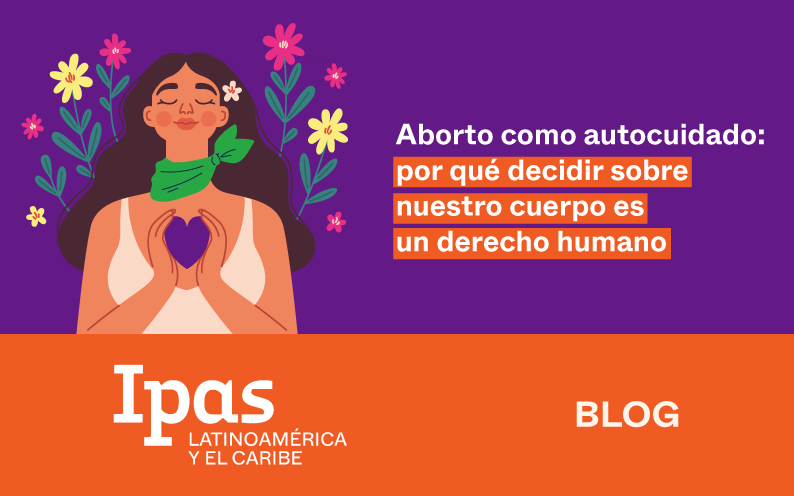
Self-care is also to recognizing and respecting that all people canan freely decide about their own bodies, with confidence, information and the necessary accompaniment.
Self-care is not just about rest, physical activity or eating well. It is also about being able to make free and informed decisions about our sexual and reproductive health and life. Therefore, to speak of abortion as a form of self-care is to speak of dignity, wellbeing and autonomy.
For many years, abortion was surrounded by silence and stigma. However, more and more people and institutions in the region agree on something fundamental: deciding whether to continue a pregnancy is a way of taking care of ourselves, protecting our health and sustaining life.
Care as a human right
Recently, Latin America and the Caribbean took important steps to recognize care as a right. The Inter-American Court of Human Rights, the region’s main human rights court, recognized that care is a human right in itself. This includes three essential dimensions: the right to care, the right to receive care and the right to self-care.
This recognition is key because it establishes that States have the obligation to guarantee conditions, time and access to services that allow people to provide the necessary care to develop their life project with autonomy. Among these services, sexual and reproductive health occupies a central place.
Along the same lines, during the XVI Regional Conference on Women in Latin America and the Caribbean, governments, organizations and specialists adopted the Tlatelolco Commitment: an unprecedented agreement to build a society of care as a basis for guaranteeing reproductive rights. The consensus was clear in recognizing that any model of self-care is essential for access to contraception and safe abortion.
In this link you can learn more about the regional conference: For a care society that guarantees reproductive rights: balance of the XVI Regional Conference on Women in Latin America and the Caribbean..
Why talk about abortion as self-care?
Understanding abortion as a form of self-care allows us to look at it from a more humane perspective that is closer to everyday life. It implies, first of all, recognizing that historically women have disproportionately assumed the tasks of caring, not only for their children, but also for processes related to sexual and reproductive health, such as accompanying pregnancies, childbirths and abortions.
From this reality, care should be understood as a right and not as an individual burden: the right to care, to be cared for and to have the conditions that make it possible. In this sense, the State has the obligation to guarantee timely, quality and non-discriminatory care, especially for those who face greater barriers and situations of vulnerability.
Recognizing care as a right also means affirming something fundamental: the right of each person to make free and informed decisions about his or her body and life project.. Deciding whether or not to continue a pregnancy is part of this right, as well as freely and autonomously choosing whether to assume, and under what conditions, the care tasks involved in motherhood.
Self-management of abortion as a practice of self-care
Talking about self-care also implies recognizing the self-management of abortion. self-management of abortion as a safe and dignified practice when performed with reliable information and affordable supplies.
Self-managed abortion is a process by which a person can terminate a pregnancy by choice and on their own. Self-care is a very safe process when appropriate medications, recommended by the World Health Organization, are used. These medications, such as misoprostol and mifepristone, have been shown to be safe and effective when used correctly.
Having clear information on doses, times and warning signs helps to reduce risks, prevent unsafe practices and protect health. In this sense, access to knowledge is a fundamental tool for self-care and reproductive autonomy.
Talking about abortion as self-care is not just a theoretical discussion. Whether with medical assistance, with accompaniment or by self-management, deciding about one’s reproductive present and future is an expression of the right to live with dignity, health, and autonomyno matter where you live or what your situation is.
To learn more about safe abortion and sexual and reproductive rights in the region, visit: https://abortoenmipais.ipaslac.org/
Recent Comments