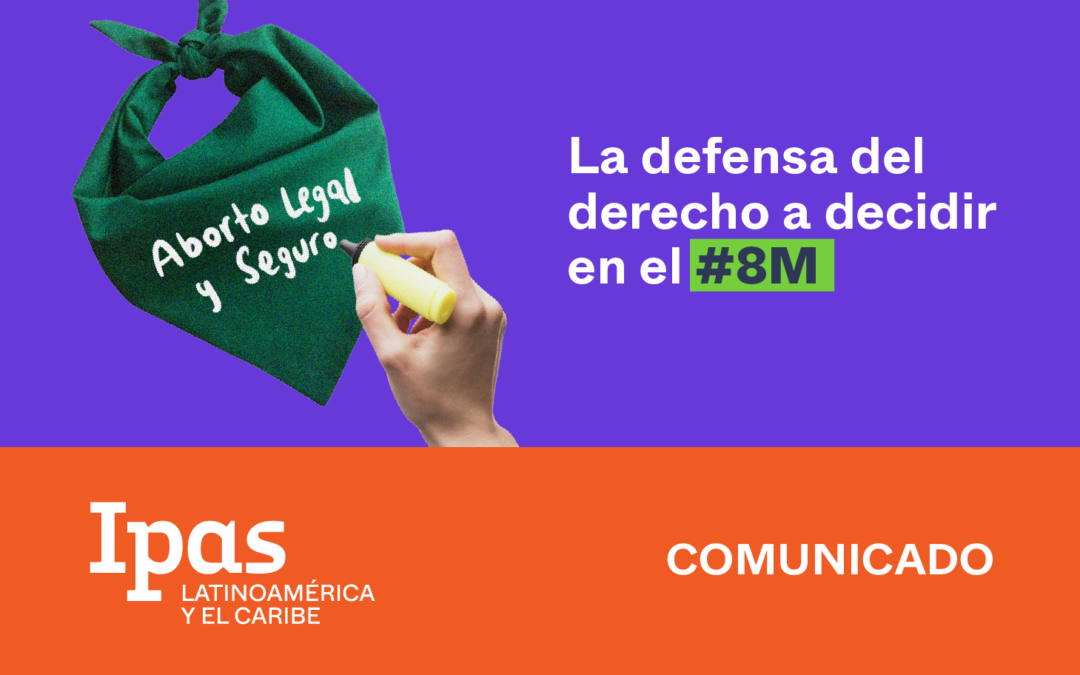
- In the framework of #8M, at Ipas LAC we reiterate the importance of raising awareness about safe abortion, so that it is addressed as a health, autonomy, dignity and human rights issue.
- We raise our voice so that no girl, woman or person with gestational capacity is forced to become a mother. Forcing motherhood is a form of violence.
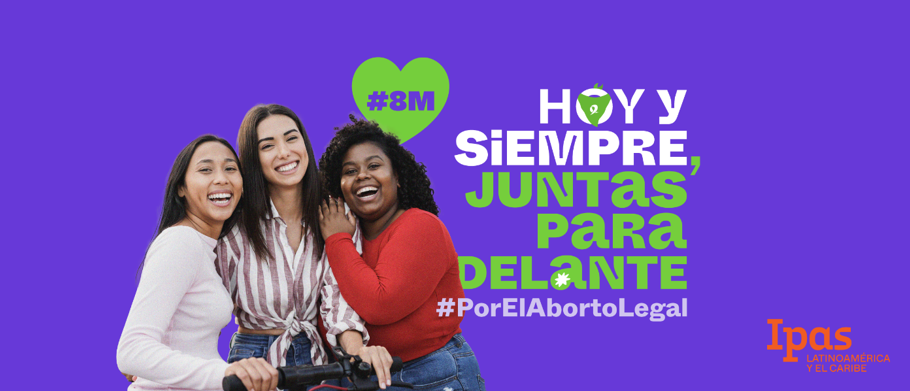
Under the slogan “Today and always, together forward,” on International Women’s Day, Ipas Latin America and the Caribbean (Ipas LAC) once again speaks out in favor of safe abortion, because when women and people with the capacity to bear children are denied the possibility of choosing over their own bodies, they are also denied their human rights; because when we talk about rights, we are talking about real lives.
In the current regional context, progress in the decriminalization of abortion must also be reflected in the eradication of stigma and discrimination against those who exercise this right and those who accompany them, as well as in the availability of options to make this right a reality. Therefore, the improvement of sexual and reproductive health policies is one of the most urgent demands to make visible this 8M.
“Eliminating abortion from the Penal Code does not force anyone to terminate a pregnancy and is a necessary and important step in a democratic society. It is about recognizing the rights of others, guaranteeing access to reproductive health services and ensuring the best conditions so that women, girls, adolescents and other pregnant women do not put their lives at risk by wanting to access an abortion,” explains Mara Zaragoza, Ipas LAC’s Strengthening subdirector.
Access to safe abortion, for all those who do not wish to or cannot continue a pregnancy, represents a halt to the perpetuation of sexist and patriarchal violence, racism, discrimination and all the structures that violate the most precarious populations, who are also those who face more difficulties in accessing safe abortion: migrants and in other contexts of mobility, racialized people, children and youth, diverse people with dissident identities and genders, sex workers, among others.
This context of inequality is related to structural violence, a set of oppressions generated by social structures (such as politics, laws, religion or cultural norms contrary to free choice), which benefit certain social groups while representing disadvantages for others. This is reflected in violence against women and girls, especially when they live in contexts of extreme violence and limited access to services and justice.
This violence also limits their ability to decide if and when they want a pregnancy, as well as their ability to seek health services, which impacts their sexual, reproductive, perinatal and maternal health.
- Studies show that women who experience intimate partner violence are twice as likely to be refused contraceptive use by the man and twice as likely to become pregnant unplanned than women who do not experience violence.
- Ipas LAC has reported how pregnant adolescents, compared to those who become pregnant after age 20, are more likely to be unemployed, ineligible and uneducated.
#8M for legal abortion
Safe abortion is a human rights issue and an essential reproductive health service that should be guaranteed by States, free from criminal and social criminalization.
When there are conditions of legality in access to abortion, the safety of the procedures increases, the availability of the best technology increases, the possibilities of complications decrease and the waiting times for a safe procedure improve. In addition, it makes it easier for women and others with the capacity to bear children to enjoy their rights to health, equality, non-discrimination, reproductive autonomy and a life free of violence.
“The access of women and people with the capacity to bear children to a life free of violence is a right that implies that no action or omission – public or private – should cause them harm or suffering of any kind: psychological, physical, patrimonial, economic or sexual; therefore, talking about safe abortion as part of 8M is a possibility to bring them closer to this right and to respect their autonomy and their physical, psychological and moral integrity,” concludes Karen Padilla, Ipas LAC’s deputy director of Programs.
Check out the livestream Deciding without guilt: let’s talk about abortion and stigma.
[1] United Nations Population Fund (2022). State of World Population 2022.
[2] Ipas LAC (2018). Sexual violence and child pregnancy in Mexico: a public health and human rights problem.
[3] Entitlement is the right to receive benefits in kind or in cash from social security institutions.
Media Liaison Coordinator:
Irene Vázquez Gudiño
[email protected] / +52 55 3428 0544
Recent Comments