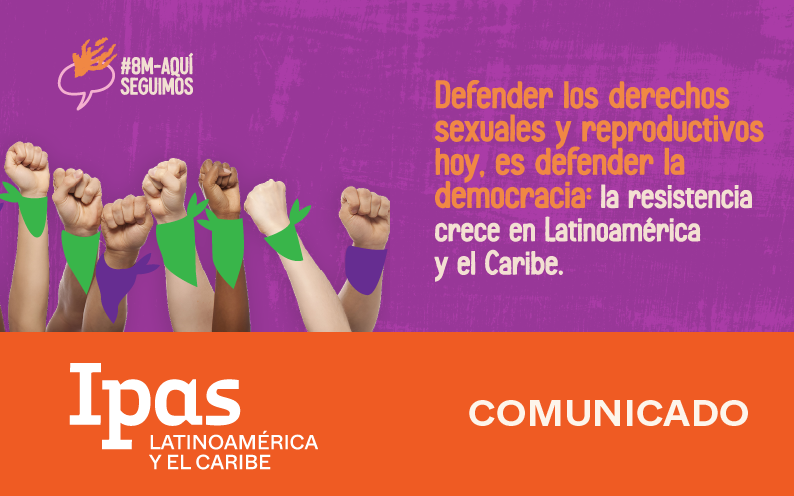
In the run-up to the 8M, Ipas Latin America and the Caribbean gives visibility to those who defend defend sexual and reproductive rights in a context of regression and polarization.
Latin America and the Caribbean are in the midst of a decisive dispute over sexual and reproductive rights on March 8, International Women’s Day. In different countries of the region, the advance of ultraconservative groups and anti-rights discourses has sought to restrict freedoms, weaken public policies and install narratives that question historical achievements in terms of substantive equality, bodily autonomy and access to fundamental rights.
Faced with this scenario, the response has not been silence. Thousands of women defenders, social organizations, health professionals, educators and activists continue to work for access to these rights, even in adverse contexts.
“When sexual and reproductive rights are challenged, defending them is also defending democracy,” says Diana Moreno Pabón, executive director of Ipas Latin America and the Caribbean (Ipas LAC).Diana Moreno Pabón, Executive Director of Ipas Latin America and the Caribbean (Ipas LAC), points out that the region is experiencing a moment of tension, but also of organization and hope.
“What is at stake is the possibility for millions of people to live with autonomy, information and dignity”.
Throughout the region, diverse voices continue to accompany, inform, and defend lsexual sexuales y reproductivsdemonstrating that progress exists because there are people who sustain it every day. From those who guarantee access to legal termination of pregnancy to those who promote comprehensive sex education., real access to contraceptiveonceptive methods and evidence-based public policies.
"Here we continue"
In the framework of March 8, Ipas LAC collected testimonies in different Latin Caribbean countries. Latin-Caribbean countries to make visible those who work to make visible those who work to advance these rights in adverse contexts. ” We are still here,” say women defenders and activists who, despite misinformation, stigma or social and criminal criminalization, continue to expand effective access from the territory.
“Aa confronting the politics of cruelty, ahere we continue to advance because we are in resistance”.. Majo Corvalán, Asociación por los Derechos de las Mujeres, Argentina.
“We recognize that, in restrictive contexts, the simple fact of sustaining feminist spaces and training women leaders generates advocacy and also the possibility of a community victory.”. Vanessa SiliezarVanessa Siliezar, Unidad de Desarrollo Integral de la Mujer y la Familia (UDIMUF), Honduras.
“Ae are here because a dignified life, and worth living, is something that is going to happen sif we build it alles togetheres. Y that summons me, summons me to try”. Laura Valenciano, Realizing Sexual and Reproductive Justice, Costa Rica.
Latin America and the Caribbean have shown that progress and attempts at regression coexist in the same scenario. In this context, collective action has been decisive in protecting freedoms, strengthening legal frameworks and demanding their effective implementation.
This 8M not only calls for mobilization and historical memory. It is also a reminder that the rights won need to be sustained collectively.
Recent Comments