
In the context of the Covid-19 pandemic, several hospitals and health centers
have prioritized the care of people with symptoms of this disease and focused their efforts
and resources on them, leaving sexual and reproductive health care on a secondary plane.
However, people continue to have sexual relations and need to have their contraceptive needs met
.
have prioritized the care of people with symptoms of this disease and focused their efforts
and resources on them, leaving sexual and reproductive health care on a secondary plane.
However, people continue to have sexual relations and need to have their contraceptive needs met
.
Given this scenario, what options do people have to prevent unwanted pregnancies,
especially when it is not easy to access health services or when you can only have
contact with health professionals through virtual channels.
In this blog, Ipas CAM recommends some options for contraceptive methods
that do not involve immediate action by health-care providers for their application and that you could
access through pharmacy sales, home delivery, online purchase or distribution
by civil society organizations.
that do not involve immediate action by health-care providers for their application and that you could
access through pharmacy sales, home delivery, online purchase or distribution
by civil society organizations.
What are contraceptive methods?
Substances, devices or procedures that prevent or significantly reduce
the chances of a pregnancy being completed during sexual intercourse.
Contraceptive methods can be classified into: Hormonal and non-hormonal. For practical purposes
and because they do not require the intervention of medical personnel, in this blog we will tell you
of the hormonal and non-hormonal options that you can access outside clinics and hospitals.
Hormonal
As the name implies, they are made up of hormones, usually some type of estrogen
and/or progestin. They act by preventing ovulation or by modifying the thickness of the tissue inside the uterus
or womb and the mucus in the cervix to prevent pregnancy. They are reversible
and widely available. They do not interfere with sexual intercourse and fertility returns
immediately after discontinuing their use. They are very effective as they have a probability of
failure between 1 and 9 pregnancies per 100 women.
and/or progestin. They act by preventing ovulation or by modifying the thickness of the tissue inside the uterus
or womb and the mucus in the cervix to prevent pregnancy. They are reversible
and widely available. They do not interfere with sexual intercourse and fertility returns
immediately after discontinuing their use. They are very effective as they have a probability of
failure between 1 and 9 pregnancies per 100 women.
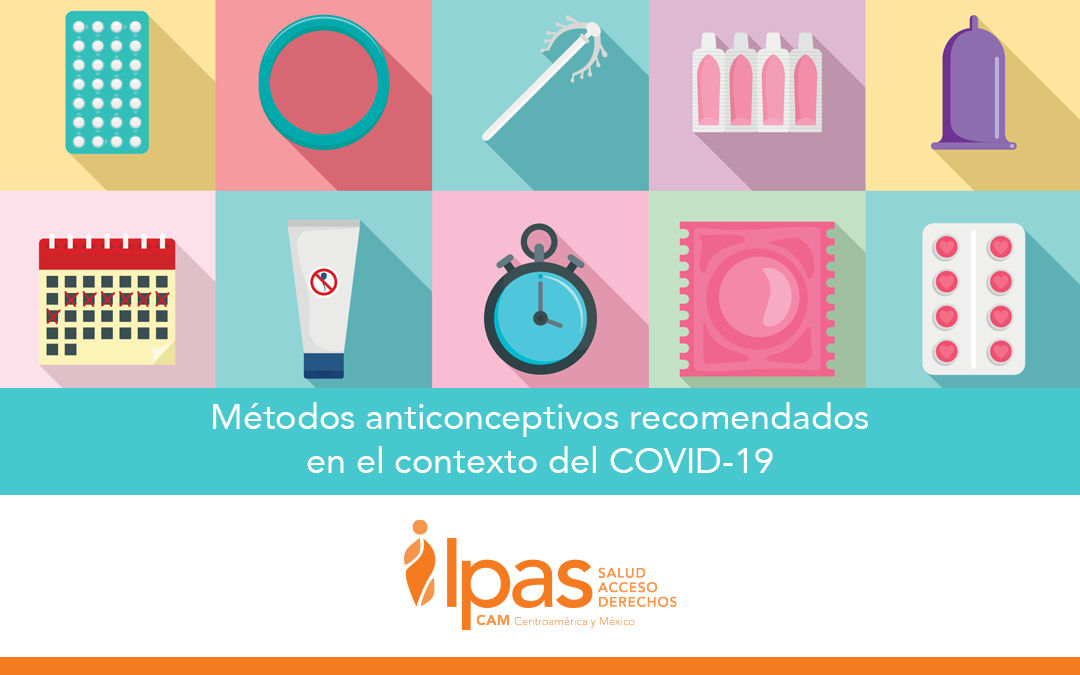
This type of contraceptive includes: contraceptive pills and injections
, the patch and the vaginal ring.
Some women may present after the use of these hormonal methods:
irregular bleeding, breast tenderness, headache, nausea, dizziness, change of mood, acne and weight change. However, it is very unlikely
that these symptoms will occur and it depends on the type of hormone contained in each method.
Please note that the emergency contraceptive pill has a lower efficacy
than other methods of regular use, so it is recommended to use it only in case
of not having another method during sexual intercourse.
Non-hormonal
Non-hormonal contraceptives are those that prevent the fertilization of the egg by
part of the sperm, with no effect on the woman’s menstrual cycle. They are generally inexpensive
and are easily available in pharmacies.
In this type of contraceptive are listed, in order of greater to lesser effectiveness:
the male condom, the diaphragm with spermicide, the female condom, the spermicide
and the cervical cap with spermicide. They have a failure rate of between 13 and 32
pregnancies per 100 users. They can be used in combination with other methods to
increase protection.
The cheapest and easiest to use are the male condom and the female condom,
their greatest advantage is that in addition to unwanted pregnancies they prevent the spread of
sexually transmitted infections (STIs), including HIV.
Disadvantages include possible allergies or hypersensitivity to the components.
Finally, within the non-hormonal methods we can find the natural methods.
They are methods that to avoid pregnancy are based on abstaining from sexual intercourse
with penetration during the fertile period through punctual monitoring (Rhythm) or avoiding
ejaculation inside the woman’s vagina (coitus interruptus). However, they are the
least effective and should be considered as a last option or used in combination with
other methods. They are not very effective, with more than 20 pregnancies per 100 couples
who use them.
They are methods that to avoid pregnancy are based on abstaining from sexual intercourse
with penetration during the fertile period through punctual monitoring (Rhythm) or avoiding
ejaculation inside the woman’s vagina (coitus interruptus). However, they are the
least effective and should be considered as a last option or used in combination with
other methods. They are not very effective, with more than 20 pregnancies per 100 couples
who use them.
IMPORTANT NOTE: Women with comorbidities, associated diseases
or cardiovascular risk factor, should consult their physician to identify
the best contraceptive option in each case.
Author: Ipas CAM