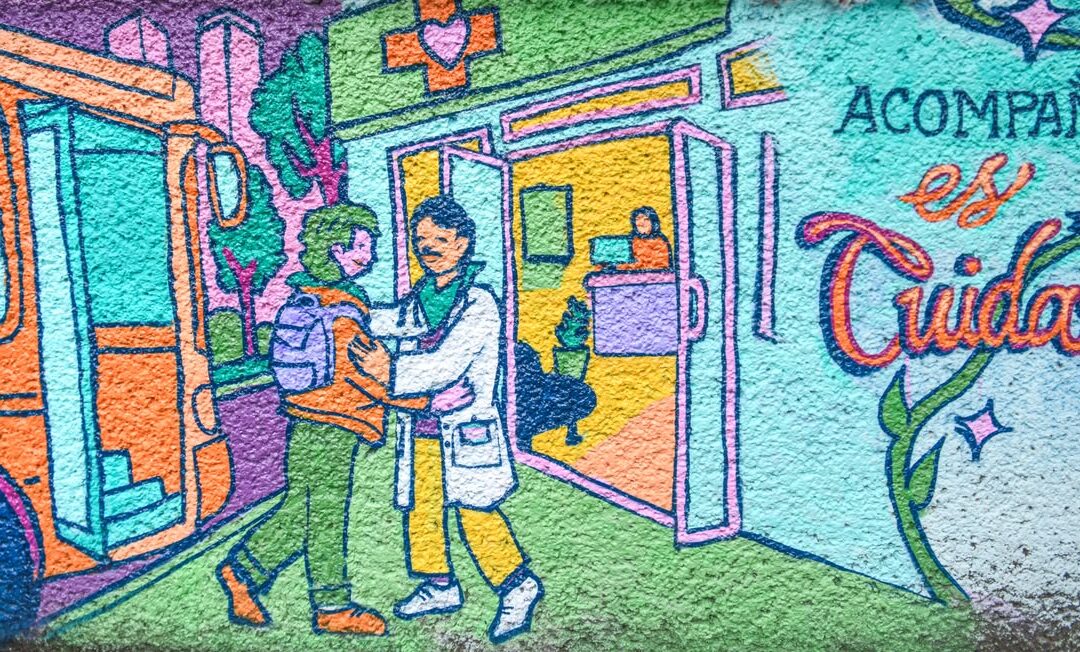
Some people walk past the murals and keep going. Others stop, take pictures of them, read the message, or talk about what they see. These are different ways of encountering a reflection that, by stepping outside the usual spaces for discussion about abortion, also finds its way into everyday life.
The murals are part of #DecidirSinMiedo, an art project by Ipas Latin America and the Caribbean (Ipas LAC) and the collective project Vulvísima, which aims to bring a conversation about safe abortion, reproductive autonomy, and the right to care into public spaces in Mexico City.
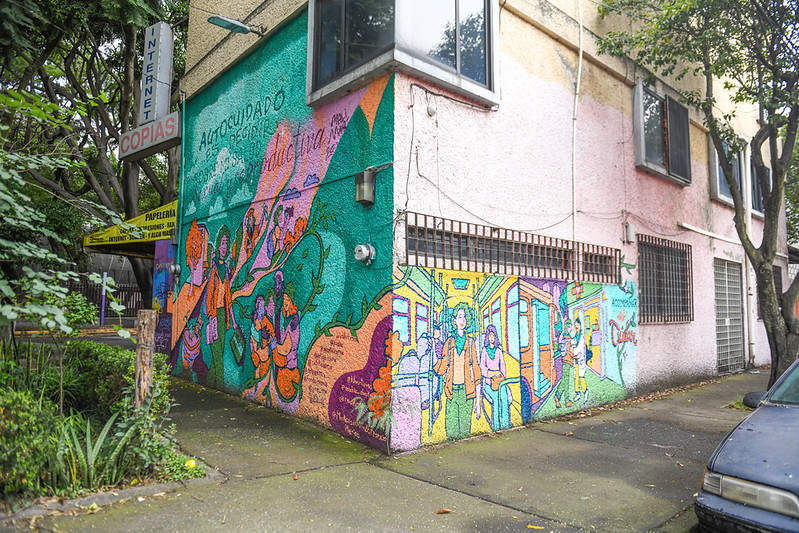
The murals are located at 65 Plan de Agua Prieta Ave., Miguel Hidalgo (across from the IPN School of Economics) in Mexico City.
Taking Ownership of Spaces
The walls became a starting point for conversations that went beyond the images and focused on the experiences, questions, and perspectives of those who encountered them.
Once the murals were finished, we asked some local residents what the murals meant to them. Here’s what they shared with us.
Damaris, a psychology student, spoke about how little people’s voices are heard on these issues: schools teach a lot about birth control methods, but very little about the experiences of those who seek them or those who need an abortion. For her, it’s not enough to approach the issue solely from a medical perspective, because behind it all are people and collective beliefs rooted in stigma.
“I think it’s very important for us to claim the spaces that have often been denied to us. I think it’s very important to have a place where you can talk with your friends about your experiences—about how you navigate such natural parts of life as taking care of yourself or making decisions about your own body. “, Damaris, a psychology student.
Balam sees something in the mural that interacts with the space.
“Mali’s style—the mural artist—is very colorful and fits perfectly with life here. (…) I remember how sexual health was such a taboo subject when we were in school, and I’d like to think that things have changed a lot. I think this project can really capture that generational shift: that it’s no longer such a taboo, and that people aren’t living in ignorance because they know nothing about sexual health. “, Balam, a local resident.
Marian spoke about self-care as an everyday practice that goes beyond rest and nutrition.
“For me, self-care goes hand in hand with being mindful of myself and my body: listening to it, paying attention to what’s going on. It also means exploring my mind, recognizing the emotions and thoughts that are there, and showing compassion and patience toward myself. I believe that from there, it can extend to others. “, Marian, a local resident.
These voices offer various perspectives on how abortion can be interpreted in everyday life: from personal experiences to questions about sexual health, self-care, and generational change.
Art as a Way to Raise Awareness
For Vulvísima, bringing this narrative into the public sphere does not mean telling people what to think about abortion, but rather opening up other possibilities for engaging with an issue that has long been shrouded in silence and stigma.
“We’re in the midst of a massive cultural and communicative conflict. In the face of that, we need to build new ways of imagining the world. Art is essential because you don’t have to explain everything. People are also tired of us constantly telling them what to think. A work of art can present something to you, make you uncomfortable, draw you in, evoke a feeling, or leave you with a question,” says Avelina Fonseca, founder of Vulvísima.
For Ipas LAC, the impact of the intervention also lies in the conversations these messages can spark.
“We want discussions about abortion—from the perspectives of autonomy, health, and care—to become part of everyday life, rather than being confined to the spaces and occasions where these topics are typically discussed. Art can open that door, but the conversation needs to be accompanied by reliable information, health services, and conditions that allow for free and informed decision-making,” says Marisol Escudero Martínez, deputy director of Advocacy at Ipas Latin America and the Caribbean.
Care is also a right
In light of the murals, this reflection also brings the issue to a less visible dimension of abortion: care. Making decisions about one’s own sexual and reproductive health requires having the conditions necessary to provide and receive care.
This perspective is linked to the Inter-American Court of Human Rights’ recognition of care as an autonomous human right, which encompasses the right to provide care, to receive care, and to practice self-care.
In the case of abortion, this means recognizing people’s right to decide on their life plans, make informed decisions about terminating a pregnancy, and have access to the necessary care to do so safely and with dignity.
Through #DecidirSinMiedo, Ipas LAC and Vulvísima aim to broaden the ways we talk about abortion and help ensure that reproductive autonomy, health, and care are also part of the conversations that take place in everyday settings.
The murals also served as a meeting point for various organizations and collectives working to advance reproductive rights on multiple fronts. The initiative was supported by Abortistas MX, Antígona, Católicas por el Derecho a Decidir, Ddeser, Di-sentir, Fondo MARIA, GIRE, Instituto de Liderazgo Simone de Beauvoir, Libertinas, Médicos del Mundo, Michis Aborteros, and REDefine CDMX.
Photographic and audiovisual material
Photos and a video of the finished mural are available in our Flickr album.

Recent Comments