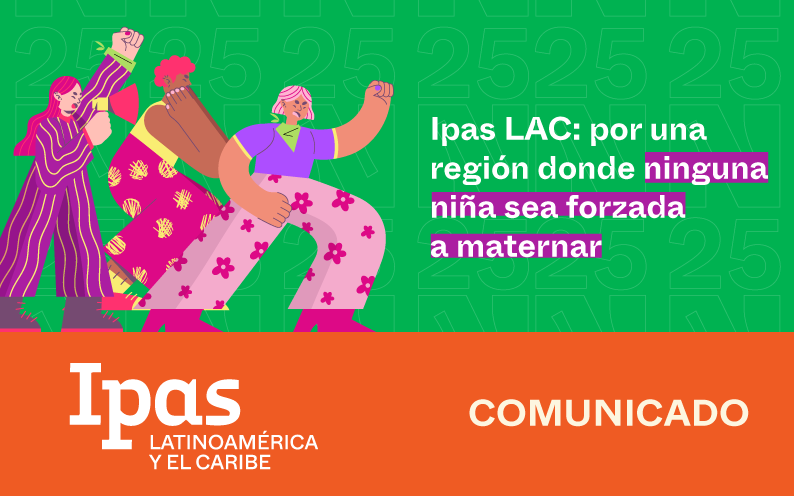
- Ipas LAC calls for ensuring safe abortion, comprehensive sexuality education, and collective care measures as pathways to justice and reproductive autonomy.
In the context of the International Day for the Elimination of Violence against Women, November 25, Ipas Latin America and the Caribbean (Ipas LAC) warns that child pregnancy remains an extreme form of gender-based and sexual violence that affects thousands of minors every year, and we must continue fighting to eradicate it.
In Mexico, for example, according to data from the Birth Information System (SINAC), between 2015 and 2024 the number of child pregnancies—that is, in girls under 15—decreased from 12,180 to 6,471 cases. However, the share of total pregnancies has remained stuck at 0.6% over the past decade, showing that the problem has not changed in proportion despite institutional efforts.
In girls under 15, pregnancy is not the result of a deliberate decision, but rather the consequence of circumstances beyond their control. Gender-based violence, particularly sexual violence, is one of the main causes of child pregnancies,” said María Elena Collado, Deputy Director of Knowledge Management at Ipas LAC.
Ipas LAC notes that most of these cases do not stem from relationships between peers, but from rapes perpetrated by adult men, often relatives or people known to the victim.
Structural violence and reproductive rights
In Latin America and the Caribbean, every year more than 1.6 million girls and adolescents (ages 10 to 19) become mothers—that is, one every 20 seconds in the region. The adolescent fertility rate remains among the highest in the world: about 50.6 births per 1,000 among adolescents aged 15 to 19, surpassed only by Sub-Saharan Africa (UNFPA, 2025).
Forced child pregnancy not only violates the right to a life free from violence; it also seriously jeopardizes the physical, mental, and emotional health of girls and adolescents, their access to education, and their ability to choose. At the same time, limited access to sexual and reproductive health services (including safe abortion) represents another form of structural violence.
“Denying abortion in cases of rape is also a form of institutional violence. To talk about abortion is to talk about self-care and human rights”, emphasized the Deputy Director of Knowledge Management at Ipas LAC
Ensuring access to comprehensive sexuality education, contraceptives, safe medications, and abortion and post-abortion care services is a State obligation. These actions not only protect people’s autonomy and health, but also help break cycles of structural violence, inequality, and poverty.
Self-care and rights: a perspective grounded in empathy
In the context of November 25, Ipas LAC invites reflection on abortion as a right to self-care, so that abortion is an informed, supported decision that protects health and life.
“The State has an obligation to ensure that no girl is forced to become a mother. Preventing forced child pregnancy and ensuring safe abortion are urgent measures of justice and reparation”, concluded María Elena Collado, Deputy Director of Knowledge Management at Ipas LAC.
Recent Comments